
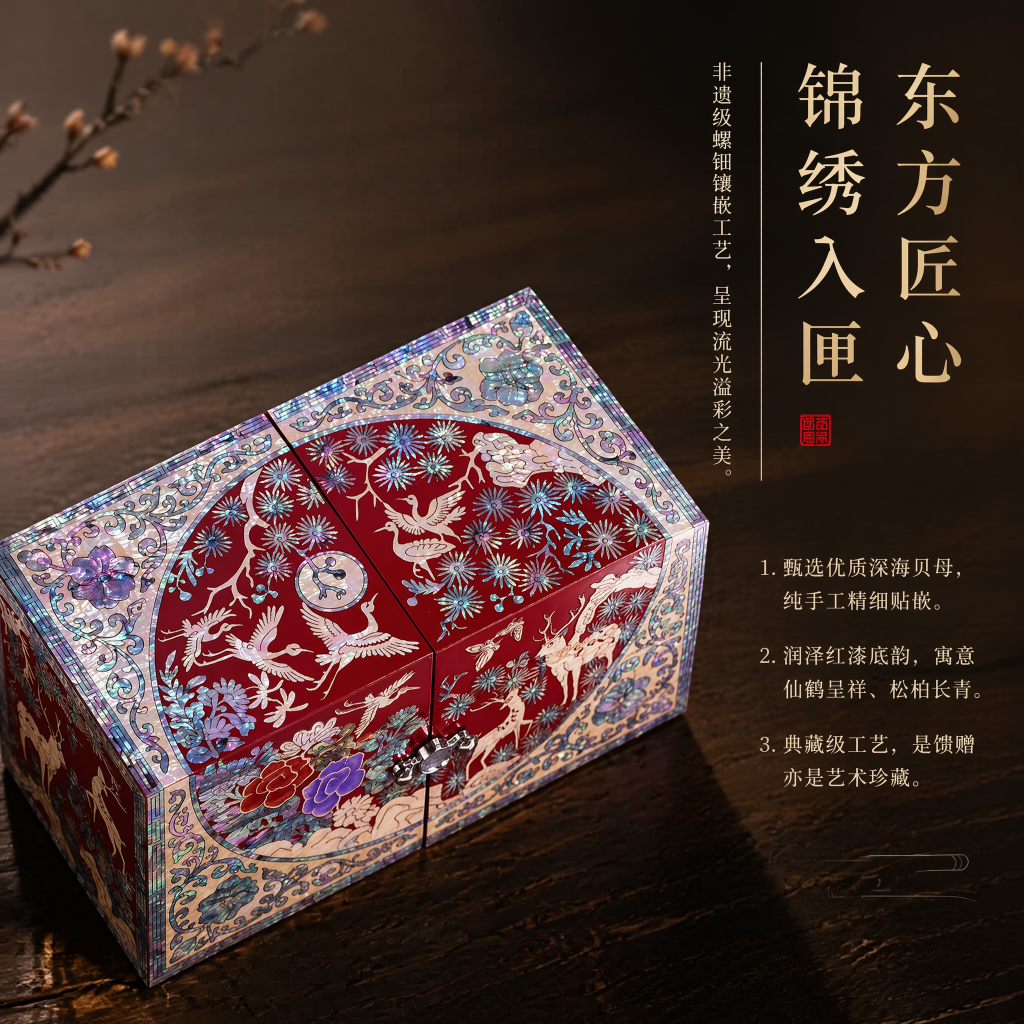
Luodian, or Chinese mother-of-pearl inlay, is one of the most delicate traditional crafts in China. It uses thin pieces of natural shell to create luminous patterns on lacquer, wood, and other surfaces.
This craft has existed for over a thousand years and is closely connected to Chinese decorative arts and refined material culture.
The beauty of Luodian lies in its relationship with light. Unlike painted decoration, shell inlay changes depending on the angle of viewing. As light moves, the surface appears to shift and shimmer, creating a quiet sense of motion within stillness.
Historically, Luodian was used in high-value objects such as furniture, musical instruments, jewelry boxes, and ceremonial items. It was considered a craft that required patience, precision, and a deep understanding of material behavior.
The process of making mother-of-pearl inlay is extremely labor-intensive. Natural shells are first selected and carefully cut into thin fragments. These fragments are then shaped and polished by hand before being embedded into lacquer surfaces. After multiple layers of finishing, the surface becomes smooth while preserving the reflective quality of the shell.
Each piece is unique. Even when following the same pattern, variations in shell texture and light reflection ensure that no two works are identical.
In modern times, Luodian continues to inspire designers and artisans. It appears in both traditional reproductions and contemporary design objects, bridging historical craftsmanship with modern aesthetics.
Beyond decoration, Luodian reflects a broader cultural idea: that beauty can be created through patience, detail, and the transformation of natural materials into lasting form.
It is not only a craft, but a way of seeing light, time, and material in a different way.